
What every band from A to H pays across the Canterbury district in 2026/27, where the money actually goes, and why the villages are billed more.
Canterbury council tax bands run from A to H, and for 2026/27 the charge in Canterbury, Whitstable and Herne Bay runs from £1,598.66 at Band A to £4,795.98 at Band H. What most bills do not make obvious is that Canterbury City Council keeps barely a tenth of what it collects. The rest goes to Kent County Council, Kent Police and the fire service. This guide gives the figure for every band, shows exactly where the money goes, explains why the villages pay more than the city, and covers the discounts and student exemptions that a lot of households never claim.
The quick answer
For 2026/27 a Band D home in Canterbury, Herne Bay or Whitstable pays £2,397.99 a year. If you live in one of the 27 parished villages, you pay a little more, because each parish council adds its own precept on top. Across the district the Band D figure runs from £2,432.96 in Thanington to £2,558.41 in Womenswold. All the figures below come from the Canterbury City Council council tax charges 2026/27 schedule.
Canterbury council tax by band, 2026/27
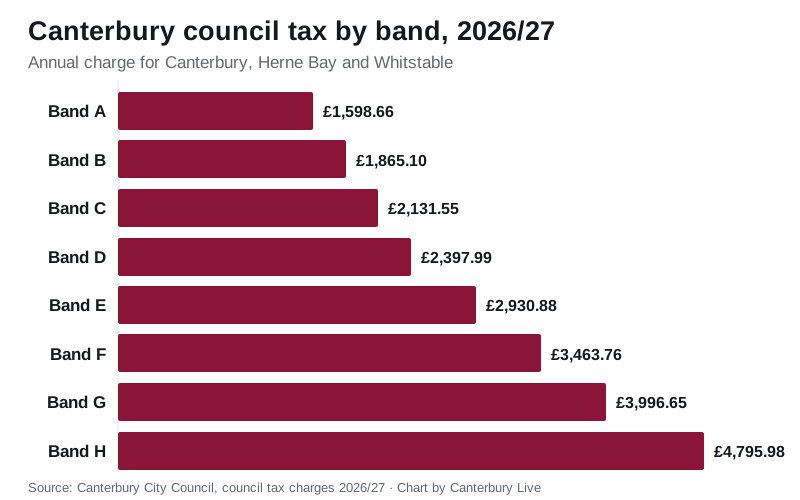
The table below is the same data, for the unparished area that covers the three towns and the bulk of the district’s households.
| Band | Annual charge 2026/27 |
|---|---|
| A | £1,598.66 |
| B | £1,865.10 |
| C | £2,131.55 |
| D | £2,397.99 |
| E | £2,930.88 |
| F | £3,463.76 |
| G | £3,996.65 |
| H | £4,795.98 |
Source: Canterbury City Council, council tax charges 2026/27.
What it means for you: at Band C, common for terraced houses and flats across Canterbury and Whitstable, you pay £2,131.55 a year, roughly £178 a month over ten instalments. At Band F it is £3,463.76. The steps are fixed in law, so moving up one band is never a small change.
What the bands actually mean
Every home in England sits in one of eight bands, and the band is not based on what your house is worth now. It reflects what the property would have sold for on the open market on 1 April 1991. That date has not moved since council tax began in 1993, which is why bands look out of step with what homes in the district actually sell for today.
The 1991 value ranges, set by the Valuation Office Agency, run from Band A at up to £40,000, through Band C at £52,001 to £68,000 and Band D at £68,001 to £88,000, up to Band H at more than £320,000.
Band D is the reference band. When any council quotes a council tax figure it is almost always the Band D one, and every other band is a fixed proportion of it: Band A pays six ninths of Band D, Band H pays double.
Where your Canterbury council tax actually goes
Canterbury City Council sends the bill and collects the money, but it keeps about a tenth. Four separate organisations set their own charge, and the council’s 2026/27 budget summary sets out each one.
| Where it goes | Band D charge | Share of the bill | Increase this year |
|---|---|---|---|
| Kent County Council | £1,758.60 | about 73% | +3.99%, or £67.41 |
| Kent Police and Crime Commissioner | £285.15 | about 12% | +5.55%, or £15.00 |
| Canterbury City Council | £254.43 | about 11% | +2.99%, or £7.38 |
| Kent and Medway Fire and Rescue | £99.81 | about 4% | +5.22%, or £4.95 |
| Total | £2,397.99 | 100% | +4.1%, or £94.74 |
Shares calculated from the council’s own Band D figures. Nearly three quarters goes to Kent County Council for adult social care, children’s services, schools support, libraries and most main roads. The police precept rose by the maximum £15. Canterbury City Council’s own share went up 2.99%, which it described as “14p per week for an average Band D property”, noting that it “only accounts for around 11% of a resident’s total bill” (budget plans).
That 11% pays for the services people picture when they think of the council: bin collections, car parks, planning, parks and leisure. For 2026/27 the city council set a net budget of £25.89m, up from £21.84m, of which £14.17m is met by council tax across 55,693 Band D equivalent properties.
Why your parish changes the figure
Canterbury district contains 27 parished areas alongside the unparished towns, and each adds its own precept, funding recreation grounds, allotments, street furniture and village facilities. It is small next to the county and police elements, but it is why two identical Band D homes a few miles apart get different bills. The Band D spread for 2026/27:
| Parish | Band D charge |
|---|---|
| Thanington | £2,432.96 |
| Blean | £2,437.17 |
| Sturry | £2,453.22 |
| Herne and Broomfield | £2,483.57 |
| Chartham | £2,487.43 |
| Bridge | £2,524.53 |
| Westbere | £2,528.21 |
| Womenswold | £2,558.41 |
Source: Canterbury City Council, council tax charges 2026/27, which lists every parish in the district. Canterbury, Herne Bay and Whitstable are unparished and pay the base £2,397.99.
What it means for you: the whole parish spread at Band D is about £125 a year from cheapest to dearest. Your band, and the county and police precepts, matter far more than which village you pick.
Students and council tax in Canterbury
Canterbury is a university city, and student status is the biggest source of council tax confusion here. The rules, from the council’s discounts and exemptions pages:
- A household of only full time students pays nothing. The property is exempt. To count as a full time student the course must last at least 24 weeks and involve at least 21 hours of study a week.
- One non student living with students gets 25% off. Students are disregarded when counting adults, so a single working adult sharing with students is treated as the only adult and gets the single person discount.
- Two or more non students in a student house pay the full charge. The disregard removes students from the count, but two countable adults means no discount.
- Under 20s in further education attract a 25% discount where a parent still receives child benefit for them.
- Apprentices earning under £195 a week are also disregarded, giving a 25% discount.
The practical point for landlords and tenants alike: the exemption is not automatic. Someone has to apply, with proof of enrolment. If a house is briefly occupied by a mix of students and non students over a summer let, the bill appears for exactly that gap.
Discounts and reductions worth claiming
- Single person discount, 25%. If you are the only adult in the property as your main home.
- Severe mental impairment. A 25% discount if one adult lives with someone severely mentally impaired, and a full exemption if everyone in the household qualifies.
- Disability relief. If the home has been adapted for a disabled resident, with an extra room, wheelchair space or a second bathroom, the bill can be charged at the band below.
- Carers and annexes. Carers are disregarded when counting adults in certain circumstances, and an annexe occupied by a dependent relative can be exempt, or attract a 50% reduction.
- Council Tax Support. A reduction on the bill itself for households on low incomes, applied for separately. Care leavers aged 16 to 21 are supported through Kent County Council’s local offer.
The premiums that go the other way
From 1 April 2026 Canterbury applies steep premiums to homes that are not lived in, per the council’s long term empty premium page. Second homes carry a 100% premium on an “empty and furnished property, which is not used as anyone’s main home”, doubling the bill to 200% of the normal charge. Long term empty homes carry premiums of 100% after one year, 200% after five and 300% after ten. In a district with a lot of coastal second homes, that first one is the change to know about.
How to check or challenge your band
Banding is the Valuation Office Agency’s job, not the council’s. A band question goes to the VOA; a billing question goes to Canterbury City Council.
To check your band, search your postcode on the GOV.UK council tax band tool. It shows your band and your neighbours’ bands, which is the evidence you need: if similar homes on your street sit a band lower, you may have a case.
To challenge your band, use the VOA challenge service, which the council points residents to from its own challenge your council tax band page. You do not need to pay a company to do it. Keep paying meanwhile, because the council is clear that “you’ll still need to pay council tax until a decision is made”, and a review can lower your band, leave it alone or raise it.
What council reorganisation means for your bill
The council that sets and collects this bill was due to be abolished, and that plan is now on hold. On 16 July 2026 the government confirmed that Kent County Council, Medway Council and the 12 district councils would be replaced by four unitary authorities from 1 April 2028, with Canterbury sitting in a new East Kent unitary alongside Thanet and Dover (ministers decide future shape of Kent and Medway’s councils).
On 7 September 2026 the government paused the whole reorganisation programme and put the July decisions under review, with no date given for the outcome (programme review and decisions withdrawal letter, Ministry of Housing, Communities and Local Government). Kent’s decision was paused rather than withdrawn.
Nothing about your bill changes because of any of this. Canterbury City Council still sets the city element and Kent County Council still sets the county element, and the 2026/27 figures on this page stand. See our full story on what the pause means for Canterbury.
Frequently asked questions
How much is council tax in Canterbury per band for 2026/27?
In Canterbury, Herne Bay and Whitstable: Band A £1,598.66, Band B £1,865.10, Band C £2,131.55, Band D £2,397.99, Band E £2,930.88, Band F £3,463.76, Band G £3,996.65 and Band H £4,795.98. Parished villages pay slightly more.
Where does my Canterbury council tax go?
About 73% to Kent County Council, 12% to the Kent Police and Crime Commissioner, 11% to Canterbury City Council and 4% to Kent and Medway Fire and Rescue. At Band D that is £1,758.60, £285.15, £254.43 and £99.81 respectively.
Do students pay council tax in Canterbury?
A household where everyone is a full time student is exempt and pays nothing, provided the course lasts at least 24 weeks with at least 21 hours of study a week. One non student living with students gets a 25% discount. Two or more non students in the same house pay in full. The exemption has to be applied for, it is not automatic.
How do I challenge my Canterbury council tax band?
Use the Valuation Office Agency challenge service on GOV.UK, which the council links to from its own challenge page. Gather evidence from similar nearby homes first, and keep paying your bill, because the council confirms you still owe it until a decision is made.
Does Canterbury charge extra for second homes?
Yes. From 1 April 2026 an empty and furnished property that is nobody’s main home carries a 100% premium, doubling the bill to 200% of the normal charge. Long term empty homes carry premiums of 100%, 200% and 300% after one, five and ten years.
Sources
- Canterbury City Council, council tax charges 2026/27, for every band in every parish
- Canterbury City Council, council tax budget summary 2026/2027, for the precept split and the year’s increases
- Canterbury City Council, where your council tax goes
- Canterbury City Council, council tax discounts and exemptions, for student, single person, carer and disability rules
- Canterbury City Council, long term empty premium charge
- Canterbury City Council, challenge your council tax band
- Canterbury Newsroom, investing in the district is driving force behind budget plans and ministers decide future shape of Kent and Medway’s councils
- GOV.UK, how council tax bands are assessed, check your band and challenge your band
Canterbury City Council’s published 2026/27 charges, checked in August 2026. Bills reset each spring, so confirm on the council’s own schedule. Our guide to Canterbury planning applications covers development near you.
Have your say