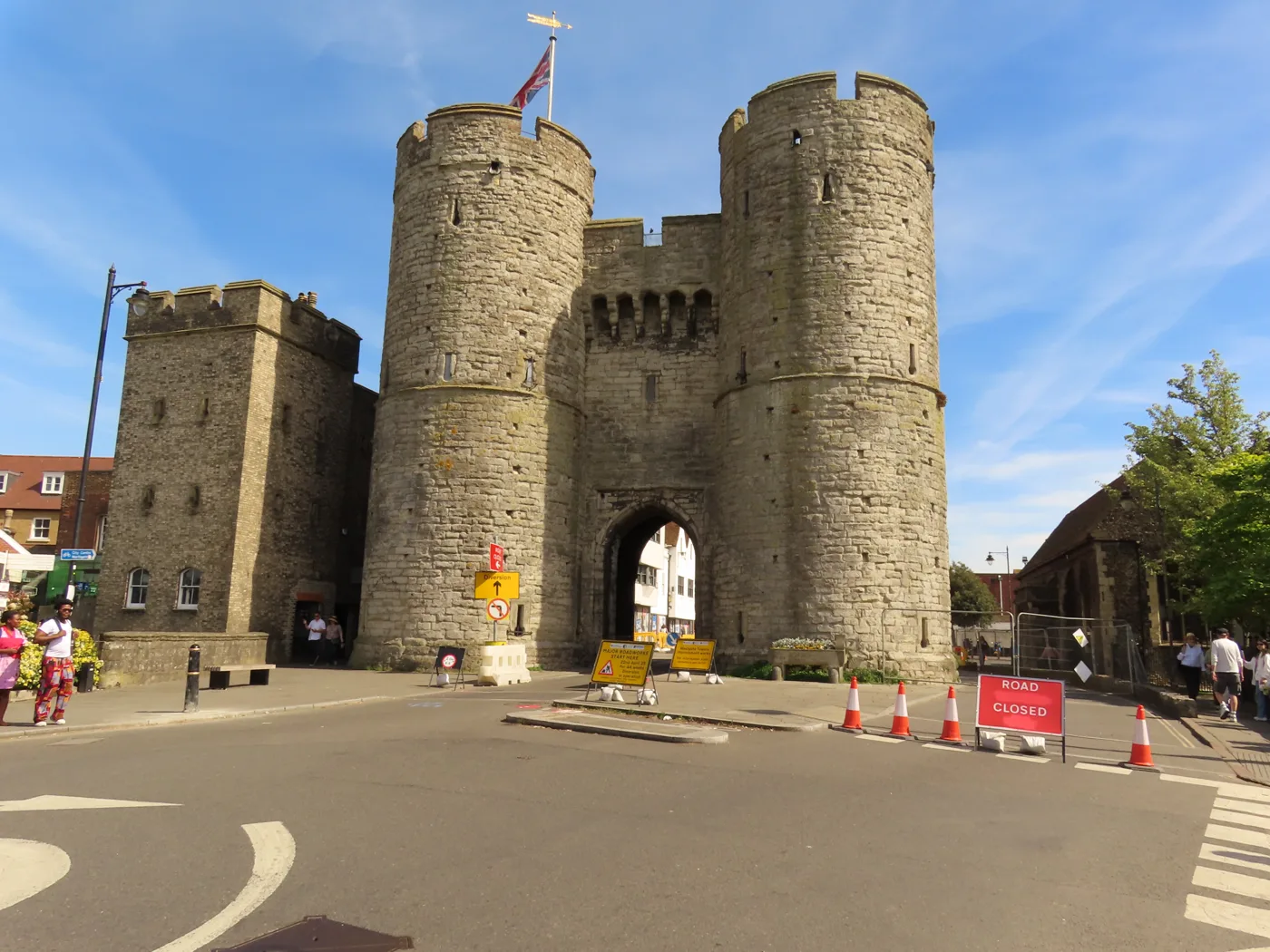

Search the council's Idox portal by postcode, no account needed. You get 21 days to comment and only immediate neighbours are written to, so set an alert.
Every one of Canterbury’s planning applications is on a public register, free to search, whether it is a rear extension in Herne Bay or a hundred homes on the edge of Whitstable. You do not need to be a neighbour, or give a reason, or create an account to look. What you do need is to know where the register lives and how long the comment window stays open, because in this district it is 21 days and most people find out about a scheme long after that has closed. This is a plain guide to searching the portal, reading the documents, commenting in a way that counts, and the two local rules, conservation areas and Stodmarsh, that catch Canterbury applicants out.
Where Canterbury planning applications live
Every application received or decided by Canterbury City Council goes on one online register, run on the Idox Public Access system. You can search it here:
The portal describes itself as pages “provided by Idox, on behalf of Canterbury City Council”. You do not need to log in to look. The council links to it from its own search and comment on planning applications page.
Type a street name, a full postcode, or a reference number, and you get the documents, the drawings, the case officer, the key dates and the comments already submitted. One quirk worth knowing: Canterbury references carry a CA prefix, and the portal tells you plainly that “you don’t need to use the ‘CA’ prefix” when searching.
How to search the Canterbury planning portal
The portal has five ways in, shown as tabs across the top:
- Simple Search. Search for planning applications and appeals by keyword, reference number, postcode or a single line of an address. You can filter by status: all, current, or decided.
- Advanced. Filter by application type, ward, date range, decision and case officer. Use this when you want everything in your ward over a period rather than one address.
- Weekly and Monthly Lists. Everything registered or decided over a period, district wide. Open the weekly list directly to see what has just landed.
- Property Search. Look up an address and see its whole planning history, which is the useful one before you buy.
- Map Search. Browse applications geographically, handy when you know roughly where something is but not the address.
Once you open an application, the Documents tab holds the drawings, design and access statements, heritage assessments and consultee responses. The Comments tab is where you read others’ representations and add your own.
Set an alert instead of remembering to check
Running the same search every week is the habit everyone abandons by the third week, and the portal will do it for you. Register a free account through the Register link, run the search you care about, usually a postcode, a street or a ward, then save it and switch on notifications. The system then emails you when a matching application is validated, which is the only reliable way to hear about a neighbour’s plans on day one rather than on day 19 of a 21 day window. An account also lets you track individual applications and manage comments you have already submitted.
What a Canterbury weekly list actually contains
The weekly list is the best tool on the portal and the most misread. Two things about it are worth knowing before you rely on it.
The volume swings wildly, so a quiet week means nothing. Counting what Canterbury validated in each of the last four weeks: 27 applications in the week beginning 3 August 2026, 51 in the week beginning 10 August, 20 in the week beginning 17 August, and 9 in the first few days of the week beginning 24 August. That is a two-and-a-half-fold swing between consecutive full weeks. If you check once and see nothing near you, that is not evidence of anything; the list is a snapshot of a week, not a trend.
Roughly half of it is tree work, not building work. In the week beginning 3 August 2026, 14 of the 27 entries were applications to fell, reduce, pollard or prune trees, mostly in conservation areas or under tree preservation orders: silver birches, sycamores, a goat willow, a weeping beech. The other 13 covered the things people picture when they think of planning: extensions, a lawful development certificate for an HMO, solar panels on a roof slope, a caravan at Chestfield Cricket Club.
That matters in both directions. If you are scanning for development near you, you can skim past most of the list quickly once you know what those entries look like. And if a mature tree near you is about to come down, that notice appears here and nowhere else, with the same right to comment as any other application. Most people never look, which is why tree applications go through unopposed.
Filter it before you read it. The weekly list form carries a parish dropdown and a ward dropdown, and a choice between applications validated in that week and applications decided in it. Canterbury’s district runs well beyond the city, so if you live in Blean, Chartham, Chestfield, Herne and Broomfield, Littlebourne or any of the other parishes on that list, set the parish filter once and the weekly list stops being a district-wide scroll and becomes a short, readable page about your own village.
How long you get to comment: 21 days
The council’s Statement of Community Involvement is explicit: “You will have 21 days to comment and further time is given when public or bank holidays are in this period.”
Not everyone gets told. The council says that “once a planning application is submitted, we will tell the immediate neighbours whose property is next to the application site”. If your house is two doors down, or across a green, or behind the site, a letter may never arrive. For larger or more sensitive schemes the council also puts up a site notice near the site, advertises in the local press, or publicises it on its website, but the safe assumption is that nobody will tell you. Watching the weekly list, or saving a search, is what closes that gap.
The exact deadline for any individual application is shown on its page in the portal, so check there rather than counting days from a letter.
How to comment, and what actually counts
Comments go in through the Comments tab on the application’s own page in the portal. One practical warning that the portal itself gives: “when submitting comments pages timeout after 30 minutes”, so write anything long in a text editor first and paste it in.
Here is the part people get wrong. A planning decision can only turn on material planning considerations. That means the planning merits of what is proposed, not how you feel about the applicant. Points that carry weight include the effect on neighbours’ light and privacy, highway safety and parking, design and the character of the area, noise, loss of trees or green space, drainage and flooding, heritage impact, and conflict with the council’s own planning policies. Points that carry little or none include loss of a private view, the effect on property values, competition with an existing business, and who the applicant is.
Two more things. Comments are published on the register, so write on the assumption the applicant will read yours. And a handful of clear, policy grounded objections weighs more with a case officer than a hundred copy and paste ones.
Speaking at the planning committee
Most applications are decided by officers. The significant and contested ones go to the planning committee, where councillors vote in public and members of the public can speak. To take a slot you must register “no later than 12.30pm the working day before the meeting”, either online or by phone on 01227 862 009, and “everyone speaking is strictly limited to three minutes” (speak at planning committee).
Slots are first come, first served once the agenda is published, normally about a week before the meeting. Only one person per household can speak, and nobody speaks more than once, so if a street is organising, agree in advance who takes the three minutes.
What the committee actually did last time
Reading one set of minutes tells you more about how Canterbury planning applications are decided than any amount of guidance. At the meeting on 21 July 2026 at the Guildhall, three applications were before the committee and none of them simply went through on the nod (agenda and minutes, 21 July 2026):
- CA/25/02094/FUL, Shelford Farm Estate, Broad Oak Road, a proposed data centre building and compound. Officers recommended granting it subject to safeguarding conditions. The committee instead deferred it for a site visit, by five votes to one with one abstention, after five speakers objected.
- CA/24/00224/OUT, Land at Bodkin Farm, Thanet Way, Herne Bay, an outline scheme for a secondary school with sixth form, up to 300 dwellings, a care home and a local centre of up to 500m² of retail. Agreed, five votes to nil with three abstentions, with the Head of Planning authorised to grant permission once a section 106 agreement is signed.
- CA/25/01454/OUT, 86A Chestfield Road, Chestfield, an outline application for a single detached dwelling and garage. Officers recommended granting it. On the vote the proposal fell.
Three lessons sit in that list. Officer recommendations are not decisions, and a committee will defer or refuse against them. Objectors who turn up and speak are visible in the record, and on the data centre item five of them preceded a deferral. And scale is no guide to outcome: 300 homes were agreed on the same night a single house was refused.
The committee normally meets monthly at 7pm in the Guildhall, St Peter’s Place, but not every scheduled date happens. The meeting listed for 18 August 2026 was cancelled, and the council’s calendar carries no documents for it, so nothing was decided in August. The next meetings are 15 September 2026 and 13 October 2026, both 7pm at the Guildhall (checked on the council’s committee calendar, 20 August 2026).
That cancellation matters more than it sounds. Canterbury officers decide the large majority of applications under delegated powers, and only the contested or large ones reach committee. A cancelled meeting does not pause the 21 day comment window on anything, and it does not stop delegated decisions being issued. What it does is push the contested items to the following month, so if you are objecting to something you expect to go to committee, check the September agenda when it publishes rather than assuming your item was heard. The agenda, reports and minutes for every meeting are published at democracy.canterbury.gov.uk, and the reports pack is the single most useful document about any contested application, because it sets out the officer’s reasoning that councillors are being asked to accept or reject.
Conservation areas, listed buildings and archaeology
Canterbury district has 97 conservation areas, which is an unusually high number and means a great many ordinary homes in Canterbury, Whitstable, Herne Bay and the villages sit inside one. In a conservation area “you will need planning permission for certain external works which would not normally need permission on other buildings” (conservation areas). On top of that, properties covered by an Article 4 direction have had further permitted development rights removed, and the council has used those extensively in Whitstable and Herne Bay.
Check before you assume anything is permitted development. The council publishes an interactive map of conservation areas and Article 4 directions and a library of conservation area appraisals explaining what each area’s character actually is, which is worth reading before you design anything.
Listed buildings are a separate regime again: you need listed building consent “for any changes which affect the building’s character”, whether or not planning permission is also required.
And there is a rule unique to the city. Canterbury city centre is a designated Area of Archaeological Importance. If your property is inside it and you plan ground works, flood works or tipping, “you must speak to us first, at least six weeks in advance”, and that applies whether or not you need planning permission (areas of archaeological importance). Six weeks is long enough to wreck a build schedule if you find out late.
Stodmarsh: why some housing applications stall
If your application is for new housing or overnight accommodation, there is a district specific hurdle. Wastewater treatment works discharge nitrogen and phosphorus into the Stodmarsh lakes, an internationally protected wildlife site, and the council’s position is that “under the Habitat Regulations, we cannot lawfully grant planning permissions that would worsen the water quality in the lakes”.
The catchments affected are those of the Canterbury (Sturry), Westbere, Chartham and Herne Bay (May Street) treatment works. Developments in them must demonstrate nutrient neutrality, in practice by buying environmental credits: “all developments will require permanent credits. If the development will be occupied before 1 April 2030, you will also need temporary credits” (Stodmarsh water quality).
For a householder extension this is irrelevant. For anyone proposing a new dwelling, an annexe let as accommodation, or a holiday unit, it is a cost and a timetable to budget for from the start.
The Local Plan behind every decision
Individual applications are judged against the development plan. Canterbury’s is the Local Plan adopted in July 2017, which “sets out plans to develop Canterbury district until 2031” (adopted Local Plan).
A replacement is well advanced, and it is the bigger decision, because it sets where development can go rather than judging one scheme at a time. The final draft was consulted in spring 2026 and is expected to go to the Government for examination in September 2026, carrying a target of 1,215 homes a year. Our Canterbury planning news page tracks where it stands, the sites it allocates and the major schemes already being decided. If you care about where new housing lands near you, the Local Plan is the document to watch, because the applications follow it.
Frequently asked questions
Why is the Canterbury weekly list full of tree applications?
Because tree work in a conservation area or on a tree covered by a tree preservation order has to be notified to the council, and those notices appear on the same weekly list as building applications. In the week beginning 3 August 2026, 14 of the 27 entries on Canterbury’s list were applications to fell, reduce or prune trees. They carry the same right to comment as any other application, and they are the ones almost nobody objects to, largely because almost nobody knows the notice exists.
How do I find planning applications in Canterbury?
Search the council’s portal at pa.canterbury.gov.uk/online-applications by address, postcode, keyword or reference number. No account is needed to view. The weekly list shows everything registered or decided across the district over the last week.
How long do I have to comment on a Canterbury planning application?
21 days from the start of the consultation, with extra time added when public or bank holidays fall inside that period. The exact deadline is shown on the application’s own page in the portal.
Who gets told about a planning application in Canterbury?
Only the immediate neighbours whose property is next to the site are notified directly. Larger or more sensitive applications also get a site notice, a press advert or publicity on the council’s website. If you want reliable notice, save a search on the portal and turn on email alerts.
Can I speak against an application at the Canterbury planning committee?
Yes, if the application goes to committee. Register by 12.30pm on the working day before the meeting, online or on 01227 862 009. You get three minutes, one person per household, and slots are allocated first come first served once the agenda is published about a week ahead.
Do I need planning permission in a Canterbury conservation area?
Often yes for work that would be permitted elsewhere. The district has 97 conservation areas, and many are also covered by Article 4 directions removing further permitted development rights, particularly in Whitstable and Herne Bay. Check the council’s interactive map before you start.
Why are some Canterbury housing applications delayed over water quality?
Because of nutrient pollution at the Stodmarsh lakes. New housing and overnight accommodation in the Canterbury (Sturry), Westbere, Chartham and Herne Bay (May Street) treatment catchments must be nutrient neutral, which in practice means buying environmental credits before permission can lawfully be granted.
Sources
- Canterbury City Council planning portal and the weekly and monthly lists
- Canterbury City Council, search and comment on planning applications
- Canterbury City Council, Statement of Community Involvement, for the 21 day comment period and neighbour notification
- Canterbury City Council, speak at planning committee, for the registration deadline and three minute limit
- Canterbury City Council, conservation areas, listed buildings and areas of archaeological importance
- Canterbury City Council, how planning applications are affected by Stodmarsh water quality
- Canterbury Planning Committee meeting calendar, for the cancelled 18 August 2026 meeting and the September and October dates
- Canterbury City Council, adopted Local Plan and the new Local Plan consultation hub
Checked against the council’s planning pages in August 2026, with the committee calendar re-checked on 20 August 2026 and the weekly list counted directly off the Public Access portal on 27 August 2026. Deadlines and statuses change daily, so confirm on the portal. See also Canterbury council tax bands and parking in Canterbury.
Have your say